
These Games were were typically board games in which players took on the role of a character (or took a role in the game) often these were cooperative games, and sometimes they even had a "game master" to play the bad guys in the game. Typically these were Dungeon Crawl games, meaning the players were exploring dungeons or castles. The dice were typically more akin to the polyhedral dice used in Role Playing games at the time than other board games. Sometimes the dice were 6 sided but they had special symbols. The games also made use of miniatures as pieces. Not only were the players pieces represented by these, but so were the monsters and villains that they would fight. If anyone had glanced into a game store and seen miniature games being played before, these games would have felt similar to that experience. It was an easy way to experience something with a low buy in price.
These games also had fun components and looked complicated. While these games may have acted as a gateway to Role Playing and other thematic gaming experiences. They were also designed to combat the perceived immersion that video games were providing. That was definitely a factor in the development of these games as well.
The games I am going to talk about here, are mostly fantasy themed. In some cases it felt like the company was more interested in selling the theme than they were a game. Most of these games had boxes with paintings of warriors and wizards fighting dragons and other monsters. Right out of the gate they conjured images of heroic quests and mighty fantasy heroes. All of that was right on the cover. It was the promise of adventure. But it was still confined to the bounds of a board game!
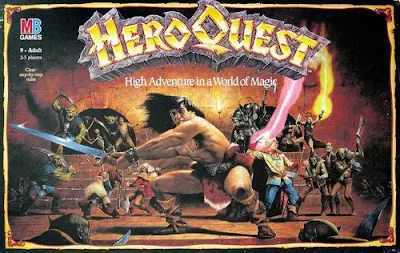 |
| The front box art for HeroQuest - Image taken from Boardgamegeek.com |
HeroQuest
The first of these games I am going to look at is probably the most popular and sought after. HeroQuest was a collaboration between Milton Bradley and British game company Games Workshop. The game focused on 4 generic heroes (Barbarian, Dwarf, Elf, and Wizard) as they traversed dungeons and fought monsters (such as orcs, Goblins, and Gargoyles) placed by Zargon (played by the another player)The game is played on a board with castle or dungeon rooms. Zargon (the game master) places furniture, doors and other provided objects around according to previously laid out maps provided in the book. The players then move around the grid on the board into and out of rooms fighting monsters and finding treasure.
HeroQuest made use of special dice with Skulls and Shields printed on them. These were used by all of the players to make their attacks and to defend against other attacks. To hit, you were looking for skulls, and to defend you were looking for shields.
The HeroQuest setting was loosely based on that of the Warhammer property that Games Workshop produced. The grim world of that dark fantasy worked translated well into the game. The most specific tie to the setting were the Chaos Warriors that served as monsters in the game.
This game was a lot of kids first experience with fantasy gaming. I have heard more than one story of kids getting their start with RPGs with this game. Which makes sense as it could be purchased at retail and there was no need to go into a specialty store to purchase the game.
The game was also expandable as there were expansions released with more miniatures and new adventures to be added to the game. This was a fairly new concept to big box store games, and was pulled directly from the hobby gaming and RPG model. It created more playability and replay ability of the game.
Check out the amazing commercial that was inundating kids on Saturday morning! What kid wouldn't want to take a crack at this game!
Legacy
Milton Bradley and Games Workshop had another collaboration called Battle Masters which was a skirmish game made for a mass market. This game more closely resembled WarHammer in terms of set up, and theme. It was less role playing but maintained the thematic piece to connect to the modern RPGs of the time.Once HeroQuest ceased publication games workshop continued the game with "Advanced HeroQuest" it was a similar concept but with a more complex set up and rule system. More recently they brought a similar system and game back with Warhammer quest.
HeroQuest is still one of the most sought after games of this era. The game is often found going for over $100. It is a desirable piece for the collection, especially for those who want to relive the experience of their gaming hay day.
Dragon Strike
/pic897658.webp) |
| Dragon Strike Bx Art - Image from Boardgamegeek.com |
Of course like all great obscure videos you can find the "Hyper Reality" video on youtube now for your enjoyment
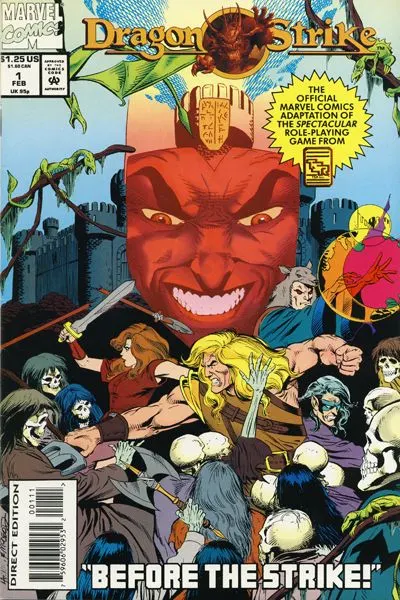 |
| Marvel Comics Dragon Strike one shot issue |
The setup is not unlike HeroQuest. The players take on the role of a Warrior, a Wizard, an Elf, a Thief, or a Dwarf as they take on monsters on boards that are set up by a player who plays the role of the dungeon master and controls the monsters of the game. These monsters include Dragons, A Scorpion Monster, Skeletons, and orcs. The setup and feel is very reminiscent of HeroQuest - with the biggest difference being that there is a timer for the game. After a number of rounds the Dragon will fly in and attack the players. This helps speed the game along for the players.
This game mechanics was an extremely simplified version of the basic Dungeons and Dragons rules. It used a D12, D10 and D8 that were color coded. Each characters card had a different colored die next to the different abilities, When the player wanted to use that ability, they simply had to find the die that corresponded to the color next to that ability.
Thematically it was very generic fantasy - The video that is included leads off with a very medieval esq castle with a jolly king having a feast. It is not really an established Dungeons and Dragons. Actually that is one of the odd things about this game. They game is very obviously an entry point into D and D, but the game is called Dragon Strike. No where on the cover of the box do the words "Dungeons and Dragons" appear. The only thing that connect the two products is the dragon in the logo is the same dragon that was appearing on the basic D and D sets at the time. At the bottom of the box it actually said it was part of "the Adventurevision Game Series," which doesn't appear to have actually become a thing after this, but this kind of thing was not uncommon for TSR at the time.
Legacy
While this is a game that I have pined after ever since I remember seeing the commercials on TV, I can't say the game itself has left much of a legacy. It was mildly successful and a few years after HeroQuest, so it is not remembered quite so fondly. Of the four games I am talking about in this post this is the one you find most inexpensively. Of course Dungeons and Dragons and the TSR properties have a huge legacy- this is a product that is part of that family, so the legacy is pretty astounding if you include that.Key to the Kingdom
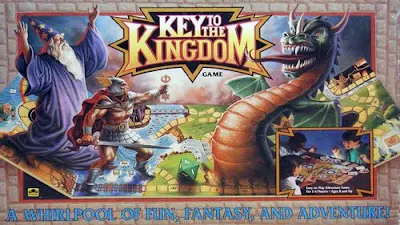 |
| Key to the Kingdom Box Art - Image taken from Boardgamegeek.com |
There are 6 parts of the board. there are the front two panels, then it opens out into 4 more panels. The board opens as players move their characters to one of two portals. Characters who have not reached the portal have 3 turns to do so. It is a fascinating point of game play. It literally turns the game upside down. This throws kinks into the other players plans, as you are all looking to find the Key to the Kingdom, but you still have to escape the board with the key before you win.
This is a fantasy trope that is not often picked up on for board games. the idea of planes, or dimension travel. It is worked right into the mechanics, an it is exciting!
This game is hard pin down. It walks a line of traditional board game and thematic fantasy game. There are elements of role playing like equipment management and fighting monsters, but it doesn't feel as ingrained on the experience as some of the others do. Still this is a game that I hear people talk about how it was their first experience with fantasy gaming and later got them excited about trying RPGs. It is also a great example of fun thematic game design.
Dark World
/pic525738.webp) |
| Dark World Box Art - Image taken from Boardgamegeek.com |
The game is full of moving parts. There are physical walls that are propped up on the board that are complete with hinged doors and secret passage ways. There are treasure chests that open to reveal weapons than can be added to the hands of the players miniatures to increase their ability. The end of the board represents the throne of the evil lord where he waits for the intrepid adventurers ready to attack. Speaking of heroes, their hit points are kept very similarly to how heroclix work. The base of the miniature twists to act as a counter for hit points. One of the strangest components of the game is a piece that sets up initiative order. It is a plastic sword with 4 colored beads inside. you shake it - then resolve turn order by moving the characters based on the order in which the beads line up in the sword. It is innovative for sure, if not a little odd. Under all of the moving parts however are extremely simple mechanics that do not benefit from the extra plastic included with the game. The characters move very linearly around that girded board. Once doors are open they are open and have no game effect. While it looks great it doesn't seem to add to the mechanics.
There is, however something to be said about immersion, and the immersion factor of the production of this game. These days it is nothing for D&D players to spend thousands of dollars on Dwarven Forge components to create the very experience that this game created out of the box. So, it is relevant to the conversations. Like the other games Dark World offered many a kid in the 90s an exciting entry point into role playing games. It had all of the thematic action that a 90s kid could want. In a very elaborate package.
Legacy:
There were several expansions put out for this game over the next few years. While the game now has a cult following it did not have the popularity of staying power that heroquest has had. The pure amount of components made it slightly more difficult to allow it to stay together, so now finding complete copies is harder. It was a game that tried very hard - and it shows with the sheer amount of components.
Other Thematic Games
 |
| Image taken from Boardgamegeek.com |
I mentioned Battle Masters above, this game was all in fantasy war gaming. It was a great way to get your feet wet into that style of game. It was also very large and took up a lot of floor space as it had a 5ft X 5ft battle grid to lay out.
/pic401239.webp) |
| Image taken from Boardgamegeek.com |
 |
| Image taken from Boardgamegeek.com |
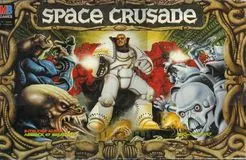
Space Crusade was another games workshop property that Milton Bradley brought to market. This time they were bring the world of warhammer 40K to a broader audience. This did not last quite as long as the HeroQuest success, but all the same it was a fin gateway into another type of gaming.
/pic244662.webp) |
| Image taken from Boardgamegeek.com |
HeroScape is a game that came out a little later. It ihit in the early 2000s. It was highly produced with interlocking terain and was more of a skirmish game than a RPG. It was produced by MB and it had a very similar dice system to heroquest. I always felt it a kind of a distant cousin to that game. It lasted for about 8 years on the shelves to varying success with lots of expansions and new master sets available.
These kinds of games still come around from time to time, but most of them are now produced by companies that produce specialized games, and there are fewer thematic games sold at the big box stores (although that is beginning to change as the game specialized game industry begins to become more mainstream). Games like Decent by Fantasy Flight games seem like a direct relation to these games. These newer games owe a lot to these games that made their way into the game aisle back int he 90s.
These 90s gateway games informed a generation who would later become gamers. They would inspired them to continue telling stories, and to find the next game when they outgrew this one. They would lead these gamers to find Dungeons and Dragons, or WarHammer or the Star Wars RPG or some other game that would lead them to the next. It is an important part of the history of the hobby, and are still really fun to play now if you can find them!